
Sex Offender Checks in King County
The King County Sheriff's Office registration page is the local starting point. It links the public search and explains which risk groups ordinarily appear. Search by place when the goal is awareness around a home, school route, park, or other point in King County. Search by name when the person is already known. The result should be treated as a current public-notification record, not a full criminal history or a statement that a new offense occurred.
The King County interface is narrower than the Washington Sex Offender Public Registry as a whole. King County law enforcement supplies and maintains registration facts for people living in its area, while the state framework governs duties and disclosure. When a possible address lies outside King County, add the national search rather than assuming the King County map covers it. For a King County court judgment or later case outcome, use the proper court record channel instead of reading beyond the registry profile.
The King County source page shows how local registration and public access meet in one office.
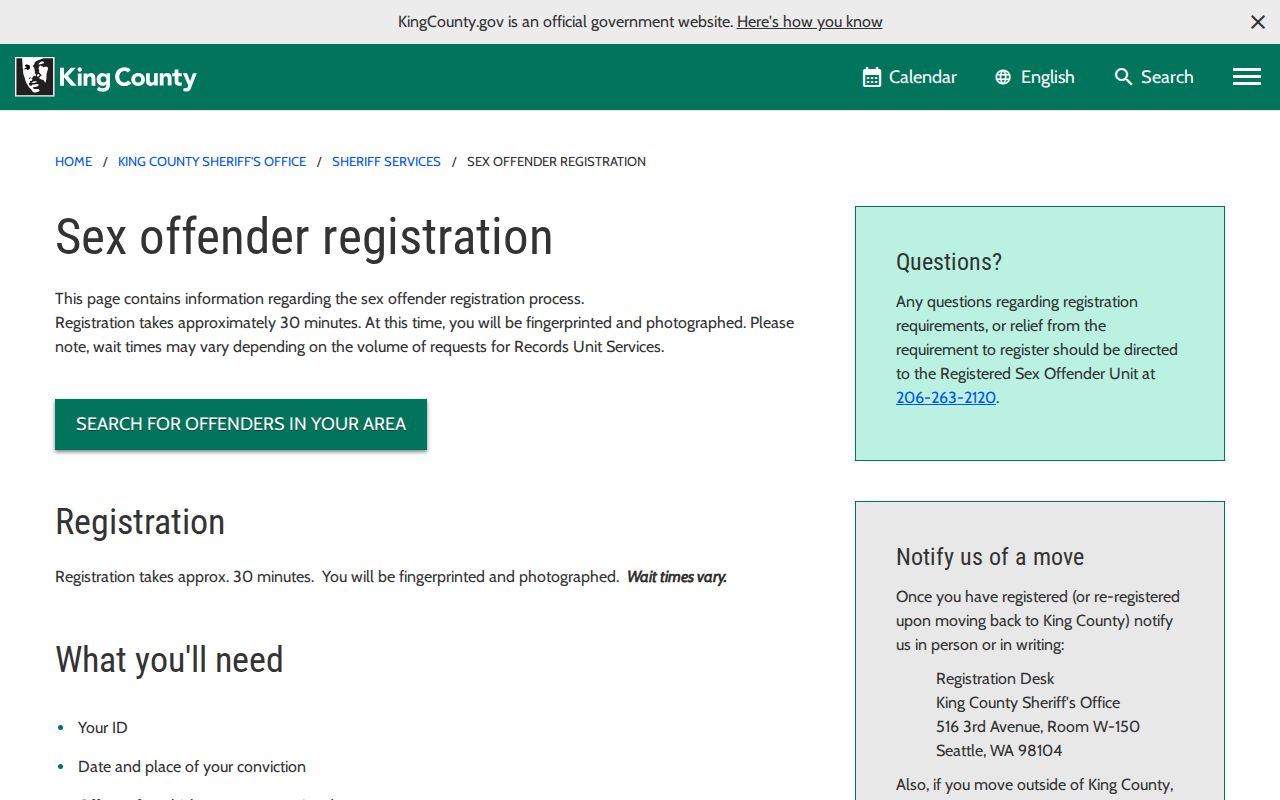
That official King County page is also the best place to confirm office hours before a registration visit.
King County Level 1 Search Gap
A blank result does not prove that no one is registered. King County describes Level 1 as low risk and generally does not place those profiles in the public search. Level 2 means moderate assessed risk, while Level 3 means high assessed risk. The local agency where a registrant lives sets the notification level and carries out the form of community notice permitted by Washington law. A kidnapping-registration category can also apply when the victim was a nonrelated minor.
This King County gap is intentional. The King County public database is built for risk-based community notice, not as a complete roster. It follows that a King County map count cannot be used to estimate every registration duty in a ZIP code. It also means King County no-result searches should be stated with care: no public profile was found using those terms, not no registered person exists.
Note: King County Level 1 status and absence from the public map do not cancel a person's statutory registration duties.
How to Search the Washington Sex Offender Public Registry
The King County public interface supports both geographic and name-based searching. Begin with the least broad terms that match the safety question. Address, city, and ZIP inputs help place results in context, while a name search helps locate a known profile. The live vendor may change radius choices, so rely on the options shown at search time rather than an old list.
- Open the King County sheriff's registry search and read any conditions or public-use notice before continuing.
- Enter an address, King County city, or five-digit ZIP for a geographic search, or use the available first and last name fields.
- Select a live radius option when offered, then compare the King County map view and result list instead of relying on one display alone.
- Open a likely King County profile and check its risk level, registration status, location, update details, and responsible agency before acting on the information.
| Field Label | Type | Required | Notes |
|---|---|---|---|
| Address | Text | For place search | Use a King County street or address point |
| City | Text or dropdown | For place search | Select a King County city |
| ZIP code | Text | For place search | Enter a five-digit King County ZIP |
| Name | Text | Alternate route | Use first and last as the interface permits |
| Radius | Dropdown | No | Confirm current choices in the live portal |
| Map or list | View control | No | Switch between King County markers and result rows |
King County Registry Beyond Borders
King County lines matter. The King County search stops at its jurisdiction, even when a King County route or family trip crosses into a nearby county or another state. The U.S. Department of Justice National Sex Offender Public Website, or NSOPW, brings participating jurisdictions into one cross-state search layer. It may require acceptance of terms or a CAPTCHA. It does not replace the King County agency that maintains a displayed profile.
The official NSOPW search page illustrates the broader layer beyond King County.
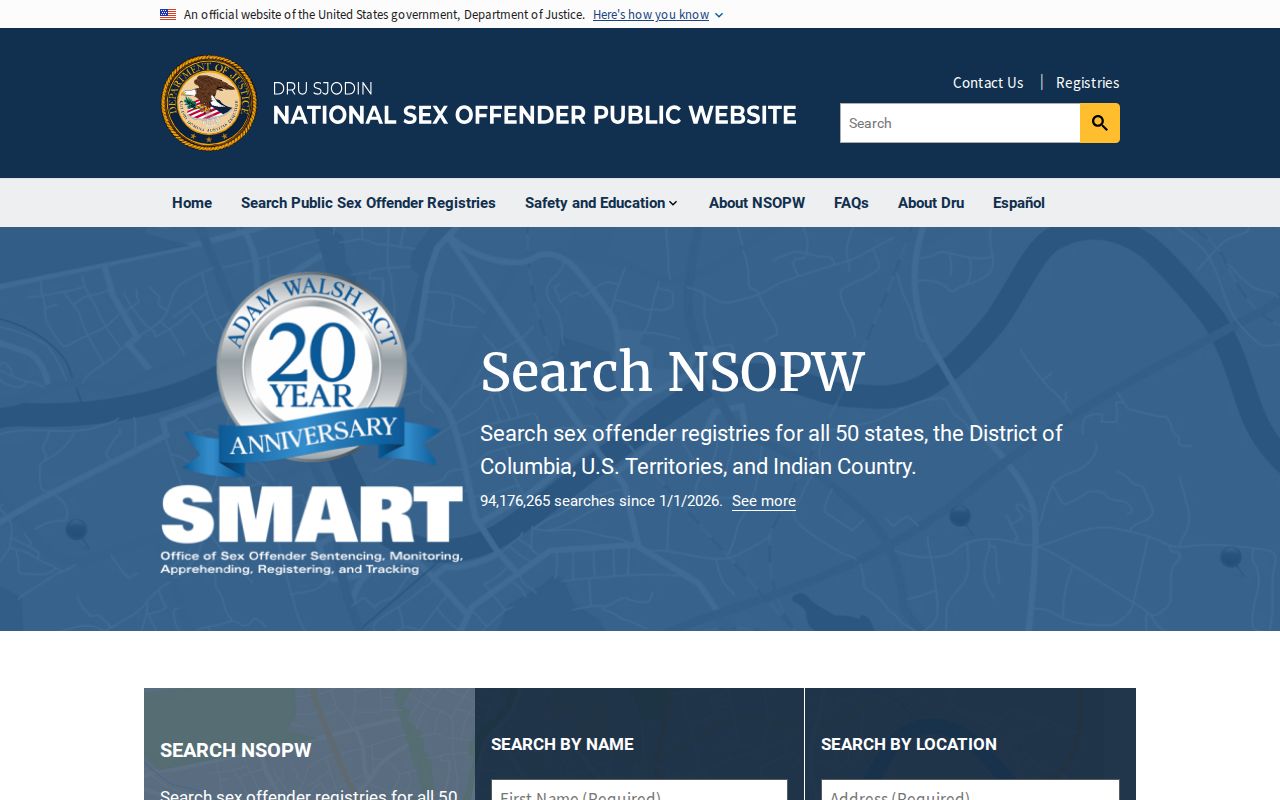
Use that national view to widen a King County location search, then confirm a result with the registering agency named in the profile. This two-stage approach reduces the chance that the King County boundary hides a relevant public listing.
Inside a Registry Profile
A King County public profile collects identity, location, offense, and registration facts that Washington law allows the public to see. Read the King County fields as a set. A photograph and aliases can help distinguish people with similar names. The King County risk level explains the community-notification category. Registration or compliance status speaks to the reported duty, while the responsible King County agency identifies the office that can verify a location or update.
| Name and aliases | Public names used to distinguish the listed person |
|---|---|
| Photo and description | Current photograph and identifying physical traits supplied for public display |
| Location | King County residence or lawful location detail, including transient status where permitted |
| Offense information | Qualifying offense, jurisdiction or statute, and supplied conviction or release facts |
| Risk and status | King County public risk level plus registration or compliance information |
| Other identifiers | Scars, marks, tattoos, vehicle, school, or work fields only when current law and the live profile allow them |
| Agency and warning | King County registering agency contact, map details, and the public-use notice |
Do not treat the qualifying offense line as proof of current conduct. Verify a King County address and update date with the shown agency when a safety choice depends on them.
King County Registry Office Schedule
King County residents who must register report to the King County Sheriff's Office at the downtown courthouse. The registration counter is separate from the sheriff's general Public Disclosure Unit and the Superior Court Clerk. That distinction matters at 516 Third Avenue because each office handles a different record. King County registration includes fingerprints and a photograph, takes about 30 minutes, and may involve a wait. The sheriff directs King County visitors to bring identification plus the conviction date, place, and offense.
KCSO Sex Offender Registration
King County Courthouse
516 Third Ave., Room W-150
Seattle, WA 98104
206-263-2120
Tuesday and Thursday, 8:00 to 11:30 a.m. and 1:00 to 3:00 p.m. Last registration is 2:45 p.m.
The King County desk is closed Monday, Wednesday, Friday, weekends, and holidays. A King County registrant without a fixed residence uses a different check-in point at the King County Administration Building, 500 Fourth Avenue, second floor. King County check-ins are Monday through Thursday, 8:00 a.m. to 1:00 p.m. and 2:00 to 3:30 p.m.
Washington Registration Levels and Requirements
Washington risk levels guide King County public notice. They do not set one matching registration term. Under RCW 9A.44.140, the duration depends on the qualifying offense and statutory category. A term may be ten years after the required clock conditions, fifteen years, or life, and rules for tolling, restart, and relief can change the calculation. Never convert a King County risk label into a term of years.
The official Washington registration-duty statute supplies the legal framework behind King County reporting.
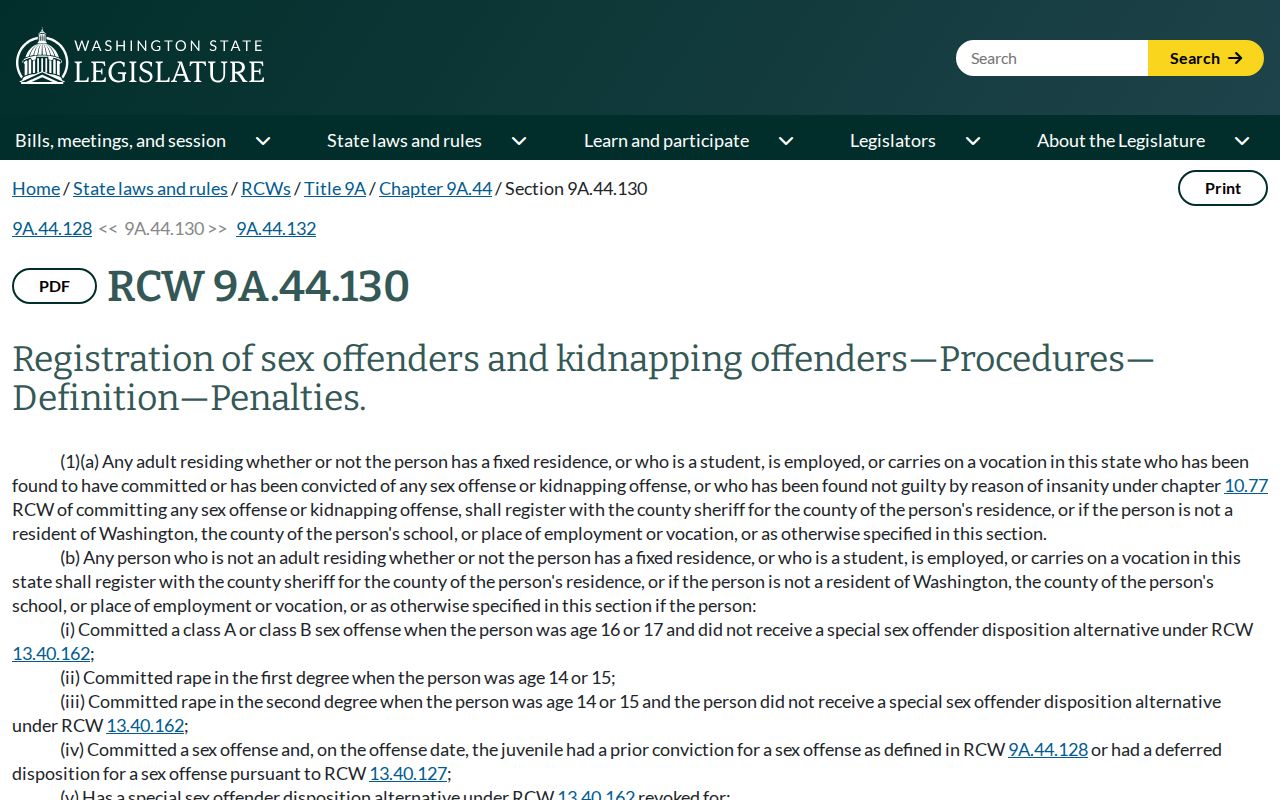
That statute addresses the duty to register and report changes; King County risk assessment remains a separate public-notification question.
| Washington category | King County description | Visibility and duration |
|---|---|---|
| Level 1 | Low assessed risk | Generally absent from public search; term comes from offense law |
| Level 2 | Moderate assessed risk | Public website and targeted notice as authorized; term is separate |
| Level 3 | High assessed risk | Website and broad public notice; term is separate |
| Kidnapping registrant | Nonrelated minor victim category | Disclosure and term follow governing registration law |
King County Registration Address Changes
King County requires address-change notice by certified mail with return receipt requested. Send the King County notice to the Registration Desk in Room W-150 at the King County Courthouse. Keep the King County mailing receipt because it documents the method and date. Moving into another county adds a second step: give written notice to King County and register in person with the sheriff in the new county as required.
For a King County registrant without a fixed residence, the posted King County check-in location and schedule at 500 Fourth Avenue apply. Those King County check-ins should not be confused with a one-time address-change letter. The King County public map may not show a street address for a transient registrant, so the displayed location granularity and agency contact carry added weight.
King County Registry Misuse Reports
Suspected failure to comply belongs with the responsible King County law-enforcement agency shown on the profile. Provide the public profile and the specific fact that appears inconsistent, such as a displayed location or status. A King County emergency goes to 911. A public user should not investigate, confront, publish private details, or pressure a registrant's household.
This local approach protects the registry's safety purpose and gives the King County agency a clear fact to check. It also avoids turning an old conviction entry into a claim of new misconduct. King County registration facts can lag or change, so the responsible agency remains the right verification point.
Community Notification and Lawful Use
RCW 4.24.550 governs King County community notification and permissible disclosure. King County level-based notice exists to help the public plan for safety. It is not an invitation to punish, threaten, or interfere with a listed person or household. Use King County data to understand an area, confirm a public profile with its source agency, and report a concrete compliance concern through official channels.
The official community-notification law shows the scope and purpose of King County disclosure.
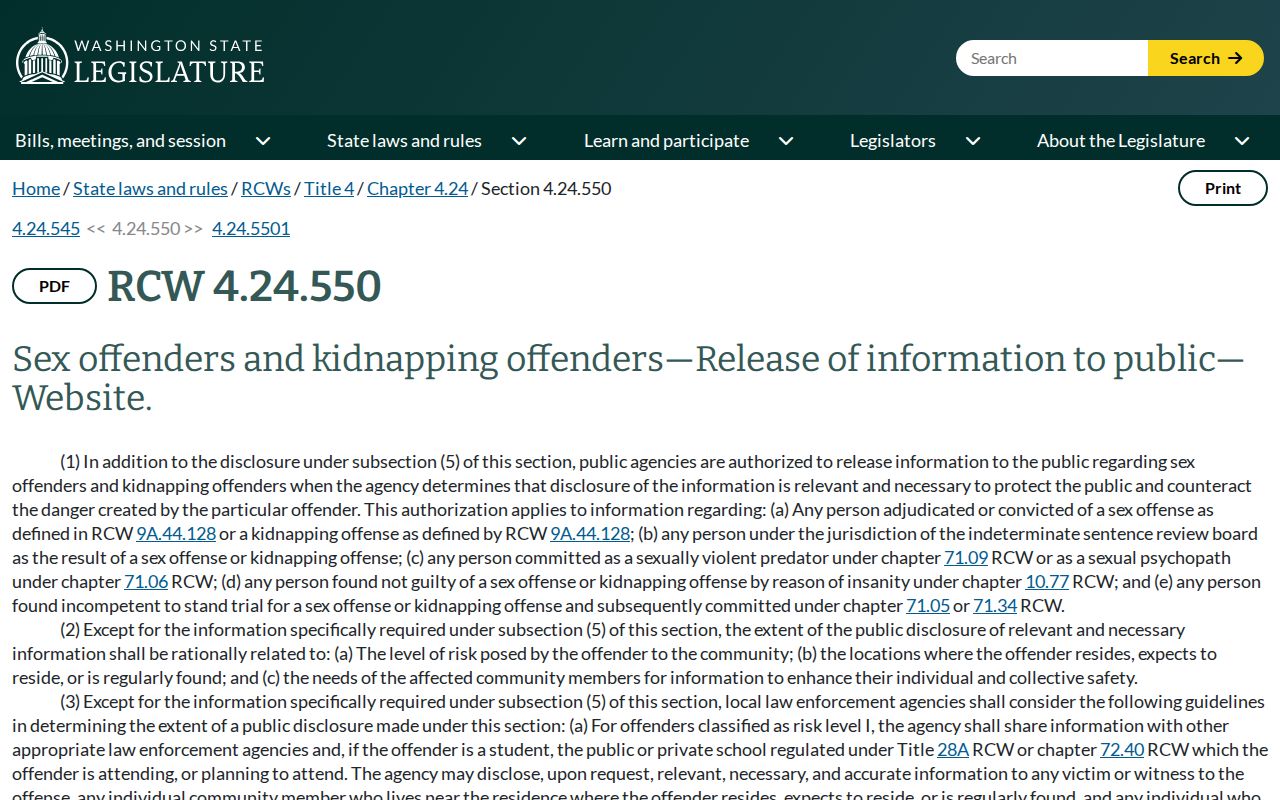
Its public-safety focus is why a profile must be read with restraint and checked against the King County agency that supplied it.
Misuse can be prosecuted: Threatening, intimidating, harassing, or committing a crime against a registrant misuses King County registry information and defeats the public-protection purpose of RCW 4.24.550.