
Checking Criminal History in Seattle
Begin with the Seattle office that created the record. Seattle police reports stay with the Seattle Police Department. City misdemeanor, gross-misdemeanor, traffic, and ordinance files belong to Seattle Municipal Court. A Seattle felony accepted for prosecution becomes a King County Superior Court file, while the Department of Adult and Juvenile Detention maintains the booking record. Washington State Patrol compiles qualifying statewide data after Seattle agencies and courts report it.
A complete Seattle criminal record search may require more than one stop. Use this order to keep an allegation, booking, filed charge, and final disposition from being confused.
- Request the incident or arrest report from the Seattle Police Department when the police narrative is the goal.
- Search Seattle Municipal Court anonymously for a city-filed case, calendar, or docket.
- Check DAJD Subject Lookup for current custody at KCCF or MRJC and note the Book of Arrest number.
- Use KC Script if prosecutors filed a felony in King County Superior Court.
- Order WATCH for the official statewide public conviction and recent-pending summary.
WATCH is broader by place but thinner by detail. It does not replace a Seattle report or Seattle court pleading, and a fingerprint comparison is the only positive identity match.
Seattle Reports and Court Records
Seattle Police and Seattle Municipal Court do not hold the same criminal records. SPD can release initial, collision, and detailed incident reports, along with calls for service, photos, witness statements, and disclosable audio or video. The report records what officers received, saw, and investigated. It does not prove that a prosecutor filed the same allegation or that a court entered a conviction.
The Seattle municipal file begins after a city charge or citation reaches the court. It can show the case number, charge, hearing schedule, docket entries, pleas, orders, and disposition. If the Seattle event leads to a felony, the operative file shifts to King County Superior Court. Readers tracing that stage can use the county's criminal court case search for KC Script and clerk routes.
| Seattle source | Best for | Not a substitute for |
|---|---|---|
| Seattle Police | Incident narrative, arrest facts, media | Filed court disposition |
| Municipal Court | City charges, hearings, orders, outcome | Full police investigation |
| DAJD | Booking and current custody | Proof of guilt |
Seattle Police Department Records
The SPD Public Disclosure Request Center handles detailed Seattle criminal records, including incident material, video, audio, photos, and witness statements. The portal lets a requester submit a description, track messages, pay an assessed charge, and download a completed production. Give the incident number when known. A precise date, time, place, involved names and roles, requested media, and date range help staff locate the right file.
The official SPD disclosure page is shown below because it distinguishes a full public-record request from faster front-counter options.
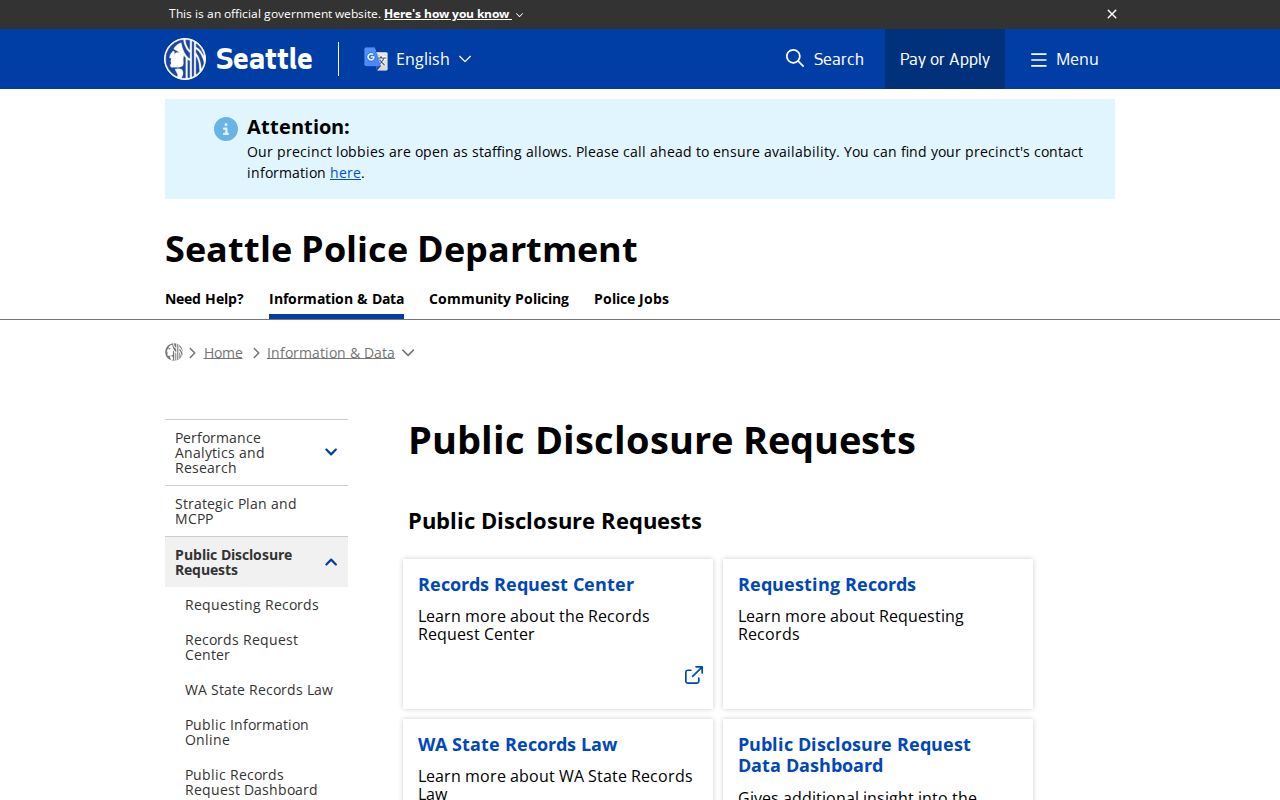
The screen leads to Seattle's managed request process rather than a countywide police database. Front Counter Services is the alternate route for an initial Seattle police report, collision report, or Seattle clearance letter, and the records line is 206-684-5454. Seattle requests themselves become public records, apart from secure payment data.
Within five business days, the city may produce the Seattle record, acknowledge the request and give an estimate, ask for clarification, or deny it with a stated basis. That period is an initial response deadline, not a promise that a large video or case file will be complete.
Search Seattle Court Records Anonymously
Seattle public users can open the Seattle Municipal Court case information page and use the left-side Search option without creating an account. The public route provides Seattle case information, records, and calendars. A login serves attorney, support, and self-represented filing tasks; it is not required merely to search Seattle court records.
The official Seattle court interface pictured below marks the search route and helps separate public lookup from filing tools.
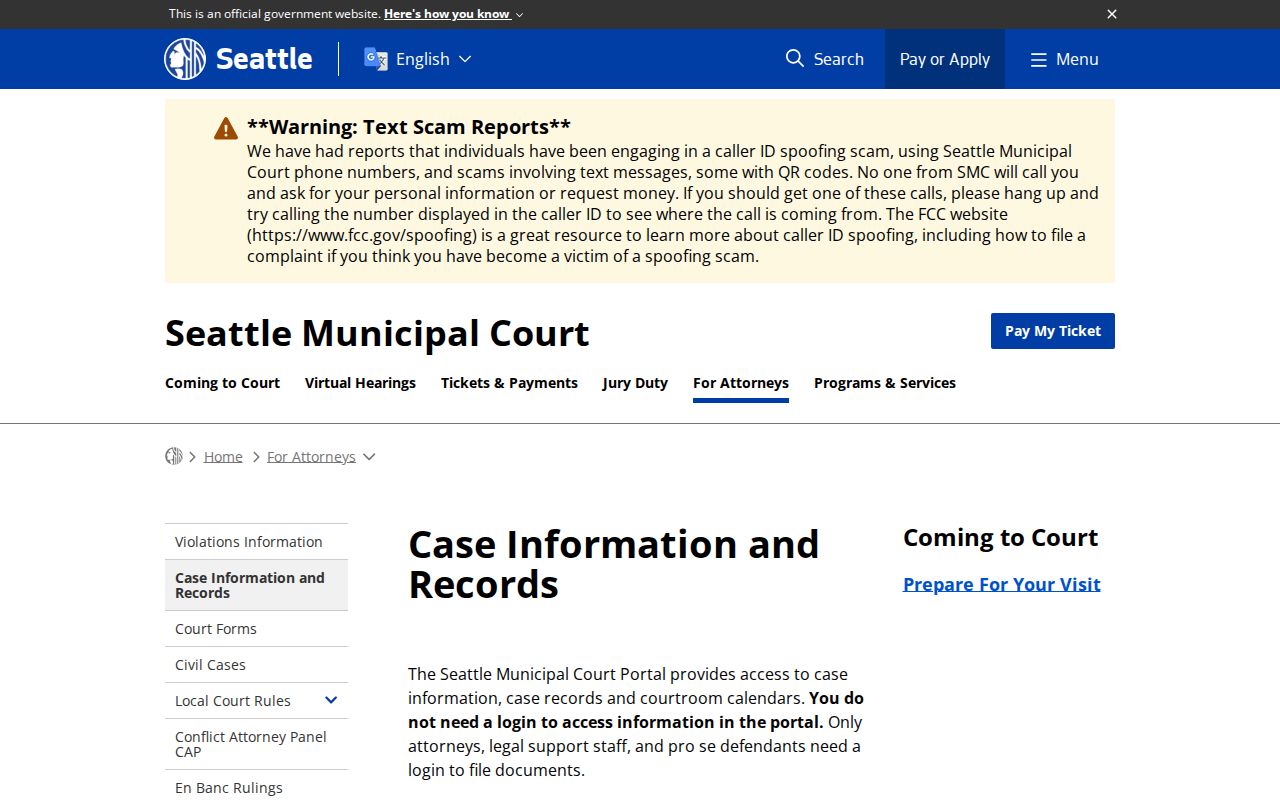
Search by the clearest case details available, then read each docket entry in sequence. A filed charge can be amended or dismissed. The judgment and sentence, when entered, state the legally operative result. City filings remain separate from KC Script even though both courts sit in Seattle.
Seattle Arrests and Bookings
Seattle Police creates the arrest report, but DAJD creates the county booking record. An adult arrested in Seattle may be booked at the King County Correctional Facility downtown or at the Maleng Regional Justice Center in Kent. Search DAJD Subject Lookup by name to learn whether the person is currently held, the facility, and the B/A number. The result may also show booking time, what the person is being investigated for, and whether bail is set.
No result does not prove that no Seattle arrest occurred. A person may have been released, moved, booked elsewhere, or not yet visible in a Seattle search. Call 206-296-1234 and check SCORE, another regional jail, or the Washington DOC locator as the facts call for. The broader King County arrest lookup explains those custody fallbacks. A Seattle arrest remains an accusation and custody event, not a conviction.
Two Seattle Criminal Record Addresses
Two Fifth Avenue addresses are easy to mix up. Seattle Municipal Court is at 600 Fifth Ave. and holds city court files. The King County Correctional Facility is at 500 Fifth Ave. and serves as the downtown jail, release point, and DAJD records mailing address. Going to the jail will not produce a municipal docket, and going to the court will not supply the full jail file.
For a Seattle police report, use SPD rather than either counter. For an older or detailed Seattle incarceration record, submit a DAJD GovQA request or contact DAJD Records at 206-477-5130 and records.DAJD@kingcounty.gov. For a city case copy, use the Seattle Municipal Court request channels. The short walk between the Seattle buildings does not merge their records.
Note: Match the building to the record before traveling; all downtown government entrances may have security screening and current access rules.
Municipal Court Records in Seattle
Seattle Municipal Court at 600 Fifth Ave. hears city misdemeanors, gross misdemeanors, traffic matters, and ordinance cases. Its clerk holds the docket and court documents. Public information is searchable online, while unavailable records can be requested by web form or PDF, by email at SMC_Copy_Requests@seattle.gov, by fax at 206-684-8115, or at the third-floor clerk counter.
| Court Name | Seattle Municipal Court |
|---|---|
| Case Types Heard | City misdemeanors, gross misdemeanors, traffic matters, and ordinance cases |
| Case Lookup Channel | Anonymous public portal; web or PDF request; email, fax, or third-floor counter |
| What the Docket Shows | Case information, charges, calendars, filings, orders, and disposition |
| Copies & Fees | Docket or documents $0.50 per page; certification adds $5 first page and $1 each added page; hearing audio $10 per hearing/CD |
Certified copies cannot be faxed or emailed. A granted in-forma-pauperis motion may support a fee-waiver request when attached as directed.
Older Seattle Criminal Case Records
When an older Seattle case is absent online, email smc_copy_requests@seattle.gov rather than treating the blank search as proof that no file exists. Supply the defendant's full name and case number if known. For hearing audio, include the courtroom and hearing date. For documents, name each item or give a tight description so the clerk can identify the existing record.
The court's records-request page explains when to use the court-record copy channel and when the general judicial public-records form applies. Its request path is shown below.
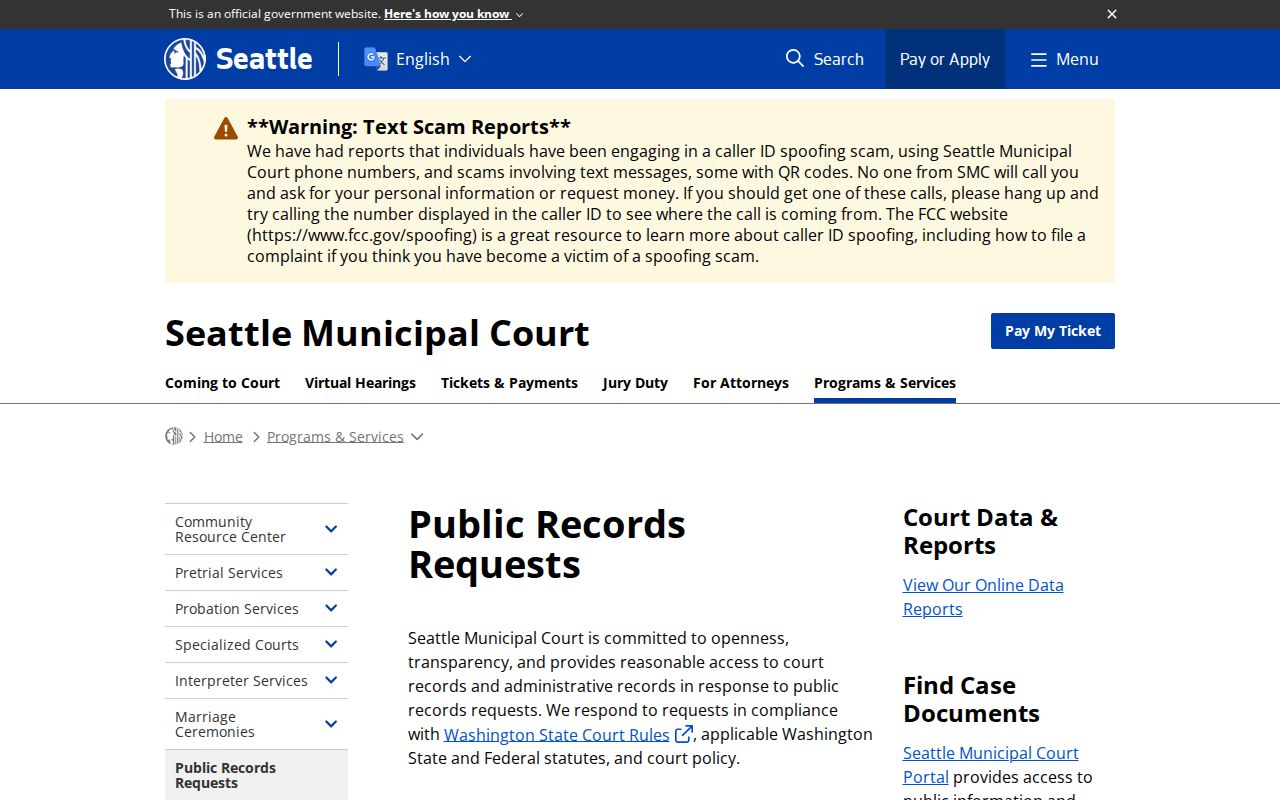
The Seattle distinction matters because a request for a case file is not handled like a request for a Seattle administrative court record. Seattle delivery can be by pickup, fax, email, or mail where the format permits.
The Seattle request form separates a docket from selected case-file documents. It asks for the request date, defendant's full name, case number, and a list of documents. A hearing recording also requires the courtroom and hearing date. The form offers Windows Media Player as the recommended audio format or FTR Gold. A plain docket or document costs $0.50 per page. Certification adds $5 for the first page and $1 for each added page. Those fields let the Seattle clerk price and locate a narrow request without guessing which hearing or filing the requester means.
Where Seattle Records Go
A Seattle incident starts with SPD. If an arrest follows, booking staff create a separate custody record and fingerprint transaction. City prosecutors may file a misdemeanor or ordinance case in Seattle Municipal Court. A felony accepted by the King County Prosecuting Attorney moves instead to Superior Court and receives a county cause number. Courts later report qualifying outcomes to WSP for the Washington State Identification System.
Record flow: Seattle Police Department › Seattle Municipal Court or King County Superior Court › Washington State Patrol
This sequence explains why one Seattle criminal record can appear before another. A jail allegation can differ from the filed count. The docket can show a dismissal that a report cannot. WATCH may lag while a disposition travels back to WSP, subject to statutory reporting windows. Compare names, court, case number, dates, and the final outcome.
Seattle Court Portal Changes
Seattle Municipal Court expanded online filing functions in 2025. Starting in April, users could submit written statements for infractions, and self-represented users gained written-statement upload in the fall. Those filing tools are distinct from anonymous public case search. A new upload feature does not move older Seattle criminal records into a new database or make restricted material public.
Public search still answers what the docket shows. Login-based filing supports a party's submission. Copy requests remain the fallback for material unavailable in the portal. Keeping those functions separate prevents a common mistake: creating an account for a public search that does not require one, then assuming that a filing dashboard is the complete public record.
Seattle's size makes that separation more than a technical detail. The 2024 Census estimate placed the city at 780,995 residents. Its port economy, interstate routes, nightlife, and role as the county seat create a wide mix of police contacts and court files. Exact crime claims still need a stated SPD dataset, year, and metric. A 911 call count is not an arrest count, and neither is a count of filed Seattle cases or convictions.
Seattle Community Custody Records
Washington calls state post-prison supervision community custody. DOC lists the Seattle Community Justice Center and several field units at 1550 Fourth Ave. S., with a main phone of 206-516-7600. Northgate and West Seattle also have field offices. These offices supervise people; they are not general city criminal-record counters.
To verify a public supervision status, start with the DOC Incarcerated Individual Search and the judgment in the sentencing court. Detailed treatment, victim, medical, risk, and supervision-plan material is not automatically public. A violation may appear in a court record after a motion, report, or warrant is filed. The case docket is therefore the sound source for a public judicial action, while the field office handles authorized supervision questions.
Public Access Rules in Seattle
Seattle police records fall under the Washington Public Records Act, while Seattle court case records are governed mainly by court rules. An agency must respond to an identifiable request, but it need not answer a question or create a new report. Victim and juvenile data, health information, personal identifiers, and sensitive active-investigation facts may be withheld or redacted. A denial should cite the basis for the withheld material.
Key Statutes and Rules:
Chapter 42.56 RCW governs access to Seattle agency records and the five-business-day initial response.
RCW 10.97.050 permits dissemination of specified conviction and current-process data while restricting other nonconviction information.
GR 31 controls public access and identifier redaction in Washington court case records.
GR 15 governs orders to seal, redact, or destroy court material.
Seattle inspection or disclosure does not turn an allegation into a finding of guilt. Use the latest disposition and verify it with the office that created the record.